industry

AI automation for accounting firms.

Extract client documents into checkable registers.

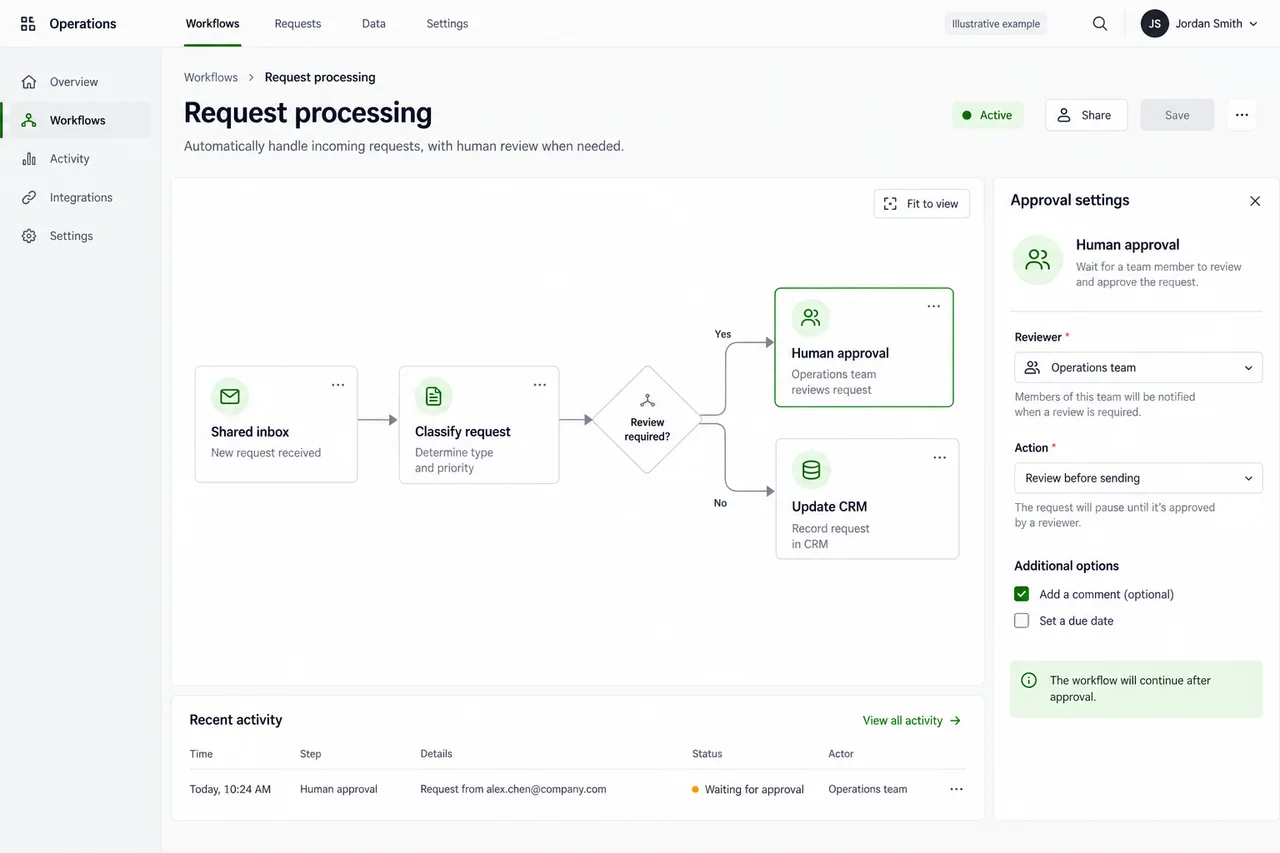
Example workflow editor connecting an inbox, request classification, human approval and a CRM update.
Illustrative application concept

Rules that travel

The IESBA Code of Ethics for accountants already covers AI. Since December 2024, it has asked accountants to judge whether a tool's output is fit for purpose, including its limits, data quality and bias, and to guard against automation bias. In 2026, IESBA put it plainly: professional responsibility can't be delegated to a machine. The FATF Recommendations put due-diligence and record-keeping duties on accountants for some client work, such as setting up or managing companies and trusts. We build registers and drafts that a person approves, and we never make the due-diligence decision. Your own regulator's rules always come first.

Which rules apply to you is your compliance or legal team's call. We map our evidence to them; we don't certify against them.

The problem

In Australia, more than a million trusts appear in the ATO's 2023–24 trust return statistics. Seniors read each client's deeds by hand, again every year end.

One register of every client trust, each field linked to its page and checked against deeds your seniors already know.

ATO, Trust statistics for Taxation statistics 2023–24, as at

How the work flows

Year end

New structures

  • Trust roles for AML/CTF due diligence

    ① Document Registers

    Only if your practice provides services under AML/CTF rules, such as AUSTRAC-regulated services in Australia.

Day to day

Staff questions

Trust register row: Example Family Trust (fictional)

Trustee
Example Trustee Pty Ltd
Vesting date
Not found in the deed
  • ok: Trustee matches the latest deed of variation
  • review: Appointor changed by a deed of variation
  • blocked: Deed of variation unsigned

Sources

  1. Trust deed Clause 12
Illustrative interface, fictional data

What we build for accounting

  • Admin Hours Audit + Switch-On

    ⑤ AI Switch-On

    The Admin Hours Audit takes 1 week and maps where staff hours go. Switch-On takes 2–3 weeks: it configures features you already own; for firms in Australia, it applies the relevant Safe-Use Kit as published, where one has been published; and it trains staff and measures the hours saved at day 30.

  • Australia

    ATO Letter Sorter

    ③ Draft-for-ApprovalOn request

    Reads each ATO letter for the action and due date, matches it to the right job and drafts the reply for a person to approve, for practices without an ATO document feed.

Use your platform's AI first

Run Karbon? Its email summaries and suggested replies are on by default. In Australia, on FYI, look at its ATO SmartDocs integration for tax-office documents. For one client's due diligence, First AML's AI document reader reads trust deeds inside the case.

What we don't do

  • We don't rebuild bookkeeping, reconciliation or GST and VAT return preparation (BAS in Australia).
  • We don't make due-diligence decisions. Your AML/CTF compliance officer does.
  • We don't give legal or tax advice, or draft engagement-letter wording.

Illustrative scenario: not a client engagement

Year-end trust review at a fictional mid-size practice

  1. Problem

    At a fictional practice of about 120 staff, seniors reopen several hundred client trust deeds each June.

  2. Approach

    Two seniors record answers for 40 deeds they know. The register reads those deeds, links every value to its page and queues anything unsigned.

  3. How we'd measure

    • Error rate for each field, with every miss listed
    • How often it says "not found" when the deed has the field
  4. What ships first

    The Two-Week Trial report: the error rate for each field, and a go/no-go.

Trust register trial at a fictional mid-size practice Illustrative trace
  1. 08:30:00 key.load Seniors' answers loaded for the deeds they know
  2. 08:31:10 deed.read Deeds and deeds of variation read from a read-only folder
  3. 08:32:05 queue.exception Unsigned deed of variation sent to the exception queue
  4. 08:47:20 report.trial Each field checked against the answers, every miss listed

A first engagement in accounting

What we need from you

  • 30–50 trust deeds your seniors know, with their answers
  • Read-only access to the deeds, or a secure copy
  • A trial window outside your peak tax season (in Australia, November to early December or April to May)

What you get

  • A trial report with each field's error rate and every miss
  • Register rows for the trial deeds, linked to their pages
  • A one-page note on where deeds are processed

The exit ramp

At the go/no-go, you decide whether to continue. If you stop, you keep the trial report, the answer key and the rows produced.

Australia: our detailed map

Australia is our home market and the one we know best.

Designed around

Works alongside

  • Karbon (Business and Enterprise plans) Read-only access
  • Xero Practice Manager Read-only access
  • SharePoint and OneDrive (Sites.Selected) Read-only access

Regulatory map

Regulatory map
ObligationWhat it means for an AI systemHow we design for itEvidence you getSource
TASA s 30-10 Code item 6; TPB(GS) 55/2026 ¶¶23–25: client permission before AI useEntering client information into an AI tool can be a disclosure to a third party, depending on how the tool is configured and used, so client permission may be needed first.A data note says which providers see client data and where it's processed.A one-page data note naming each processor, its region and its retention settingSource, as at 22 July 2026
APESB Technical Alert (31 Oct 2025): APES 110 applies to AI useMembers using AI must keep meeting APES 110 and critically assess and verify AI-generated information, and the APESB says they should disclose and supervise AI use.Every register field links to its page, so a reviewer can check it.A register with a source-page link per field, and a test report listing every missSource, as at 31 October 2025
Privacy (Tax File Number) Rule 2015 ss 10, 11: use limits and safeguards for TFNsEvery holder of TFN information, whatever its size, may use or disclose it only for tax, superannuation or personal-assistance law purposes (or to give individuals their own TFN information), and must take reasonable steps to protect it.TFNs are masked before any model call unless the job needs the field.A masking test result that lists any TFN left unmaskedSource, as at 4 March 2015
Privacy Act APPs 6 and 11: personal information entered into AI productsFor practices the APPs cover (generally turnover over $3m; smaller ones only in listed cases), putting personal information into an AI product is a use or disclosure under APP 6, and APP 11 requires reasonable security steps.Where the provider offers the setting, tools are set so it doesn't train on what you enter.A region note stating where inference runs and what the provider retainsSource, as at 17 January 2025
AML/CTF Act s 28 (from 1 Jul 2026 for table 6 services): initial CDD for a trust customerA practice providing AUSTRAC-regulated services, such as setting up or restructuring a trust, must establish a trust customer's trustees, beneficiaries or their classes, and beneficial owners, among other matters. AUSTRAC names the deed and deeds of variation for verifying the trust's details, not individuals' identities.Each role links to its deed page; your AML/CTF compliance officer signs off.A trust register with a page link per field, and an exception listSource, as at 5 May 2026

Last reviewed

General information, not legal advice.

Questions

Why not just use Karbon's AI, or FYI's ATO SmartDocs integration?
Use them first. Neither reads your trust deeds into a register you can check field by field.

Related insights

Questions

Have you built this for other accounting practices?
No. Techsider has no clients yet, in accounting or anywhere else, so you start with a Two-Week Trial on deeds your seniors know.
Do we need client permission before our deeds go through your system?
Possibly, and more likely if we run it for you. It depends on the confidentiality rules you work under: in Australia, the Code item 6 row in the regulatory map sets out what the TPB says. You get a data note naming every processor, and your adviser decides whether your terms cover it.
Where is the data processed?
The register runs in the cloud region you choose, in your own Microsoft or AWS account, or in an Australian region if we manage it for you. Our team reaches it remotely from Sydney, under the data-transfer terms in your contract. For Switch-On, you see each vendor's processing location where it's published.
What happens when the AI model changes?
The test on your answer key is re-run before the new model is used, and you see old and new results side by side.

Let’s discuss your workflow.

Talk to us about AI for accounting