industry

Every approval condition, on a register you can check.

Track approval conditions and surface current procedures.

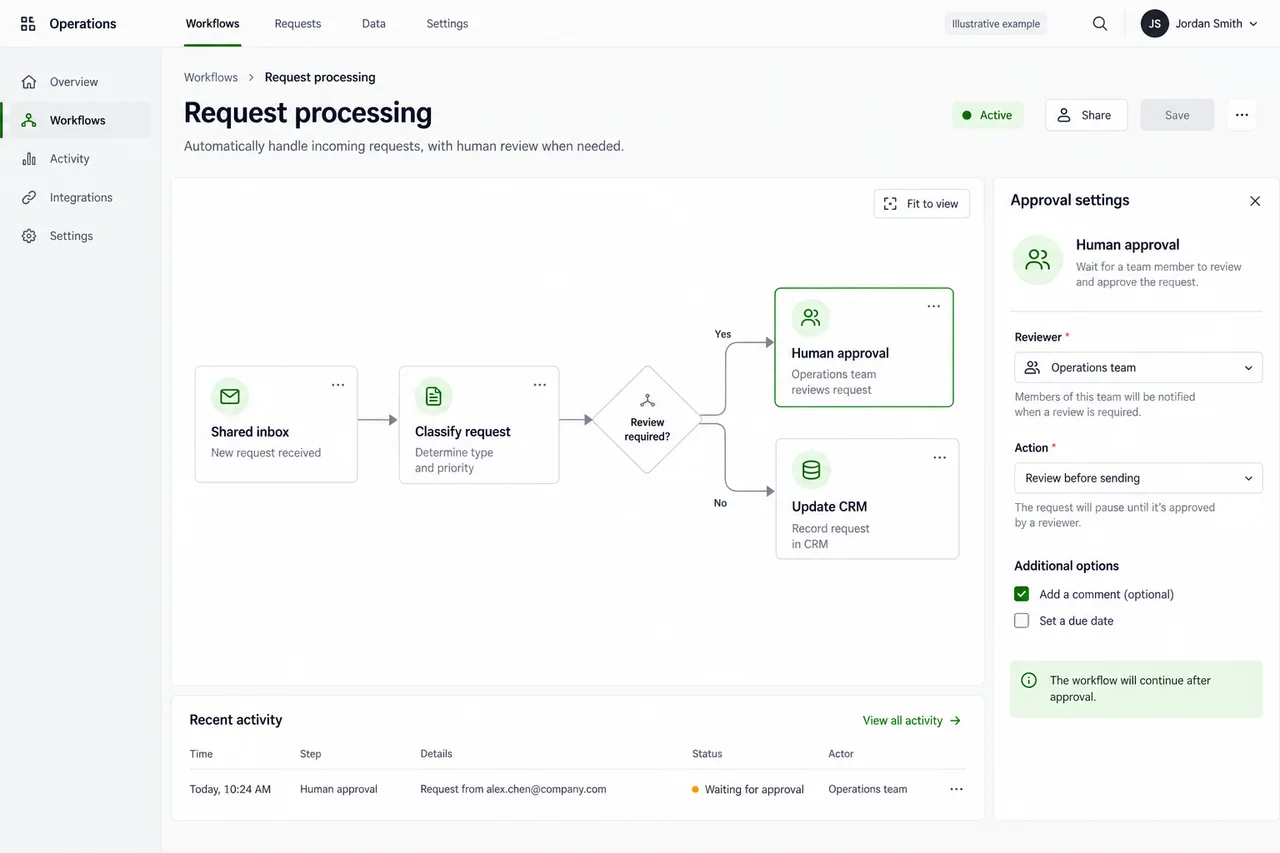
Example workflow editor connecting an inbox, request classification, human approval and a CRM update.
Illustrative application concept

Rules that travel

Approval conditions are written locally, but tracking them is a shared discipline. ISO 14001, revised in April 2026, asks you to know your compliance obligations, including the conditions attached to your permits, and to check you're meeting them. IEC 62443 covers the security of operational technology, and the 2025 joint principles from cyber agencies in seven countries ask critical-infrastructure operators to test AI in operational technology continuously. We build a register of every condition, each linked to its source clause, and an assistant that answers only from current procedures. Your own regulators set the conditions; we make them easy to check.

Which rules apply to you is your compliance or legal team's call. We map our evidence to them; we don't certify against them.

The problem

In Australia, the regulator records approval holders who failed to publish annual compliance reports, implement approved management plans or report non-compliance.

One register where every condition links to its page, with the error rate measured before anyone relies on it.

DCCEEW, Compliance outcomes (EPBC Act), as at

How the work flows

Approvals

Procedures

Shifts and field

Risk and suppliers

Conditions register: fictional approval

Condition
Rehabilitate cleared areas under the approved plan
Evidence required
Rehabilitation monitoring report
  • ok: Linked to its page in the approval
  • review: Due date set by a plan clause, sent to a person

Sources

  1. Approval notice Condition 12, page 14
Illustrative interface, fictional data

What we build for resources & energy

Use your platform's AI first

If your procedures already live in Mitti (by SafetyCulture), try its AI Assistant first. We build for the manuals and work instructions outside it.

What we don't do

  • Predictive maintenance, vision QA, orebody modelling or digital twins. Specialist products do those.
  • AI policy paperwork. Your risk and policy owners write policy.

Illustrative scenario: not a client engagement

One approval, one conditions register.

  1. Problem

    A fictional mid-tier miner holds two approvals for one project, and its environment lead rebuilds a conditions spreadsheet whenever a plan changes.

  2. Approach

    The system reads the approvals without changing them, turns each condition into a row linked to its page, and sends unclear rows to the environment lead.

  3. How we'd measure

    • Conditions missed or misread against the answer key
    • How often it flags a row instead of guessing
    • Time the lead spends checking the register
  4. What ships first

    A draft register for one approval, with page links and its error rate.

One approval read into a conditions register Illustrative trace
  1. 07:30:00 condition.extract Condition read into a register row
  2. 07:30:01 row.link Row linked to its page in the approval
  3. 07:30:03 row.flag Unclear due date sent to the environment lead

A first engagement in resources & energy

What we need from you

  • One approval and its plans, with read-only access.
  • The conditions your team already tracks, as the answer key.
  • A person to make the go/no-go call in week two.

What you get

  • A draft register, each row linked to its page.
  • The error rate, with every miss listed.
  • A one-page data note showing where each step ran.

The exit ramp

At the go/no-go in week two, you decide whether to continue. If you stop, you keep the draft register, the answer key and the test results.

Australia: our detailed map

Australia is our home market and the one we know best.

Designed around

Works alongside

  • Microsoft SharePoint Read-only access
  • Oracle Aconex Read-only access
  • Mitti (by SafetyCulture), Premium or Enterprise plan Read-only access
  • IBM Maximo Drafts a person actions

Regulatory map

Regulatory map
ObligationWhat it means for an AI systemHow we design for itEvidence you getSource
CIRMP Rules ss 6(d) and 7(1)(b)–(c): sensitive operational information stored, transmitted or processed outside AustraliaFor critical electricity, gas, water and liquid fuel assets, layout diagrams, schematics, configuration information and other data a reasonable person would consider confidential or sensitive about the asset are sensitive operational information. Storing, transmitting or processing them in a model, index or log store outside Australia is a material risk your CIRMP has to identify and, as far as reasonably practicable, minimise or eliminate.Every step we build, including model inference, is designed to run in an Australian region. Inside a platform you already license, we show you where the vendor runs it.A data-flow map showing where each step runsSource, as at 10 June 2026
CIRMP Rules s 8A(2)(c)–(d): risks from advanced, novel or emerging technologyThe Rules don't define the term; the Explanatory Statement says it captures technology such as AI. Deploying or hosting AI in a way that could prejudice the asset's availability, integrity, reliability or confidentiality is a material risk the CIRMP has to minimise or eliminate, so far as reasonably practicable. For assets that were CI assets before 10 June 2026, Home Affairs gives 10 June 2027 as the date to comply by.What we build reads your documents without changing them, anything it drafts waits for a person, and it is re-tested when the model changes.A test report listing every failure, and each re-test recordSource, as at 10 June 2026
Coal Mining Safety and Health Regulation 2017 (Qld) s 11: current SOPs easily accessibleA Queensland coal mine's site senior executive must keep a list of current SOPs, and the current SOP for each activity, easily accessible to the workers doing it, in a format that's easy to use and understand. An assistant that answers from a superseded SOP works against that, and it doesn't replace the list or the copy.The assistant answers only from SOPs marked current, shows the version it used, and says so when the SOP is silent.A test report and the list of SOP versions indexedSource, as at 1 September 2026
Mining and Quarrying Safety and Health Regulation 2017 (Qld) s 115: only current procedures in useAt a Queensland mine or quarry other than a coal mine, the site senior executive must control the issue and availability of written procedures and standard work instructions so only current versions are in use, and make copies of the current ones available to the workers they apply to. An assistant that answers from a superseded version works against that.The assistant answers only from current versions, drops superseded ones, and shows the version number and issue date it used.A test report and a log of versions indexed and removedSource, as at 27 March 2026

Last reviewed

General information, not legal advice.

Questions

We run a SOCI-covered asset. Where would our data be processed?
Every step we build, model inference included, is designed to run in an Australian region. If your model isn't available there, we tell you before build. Inside a platform you already license, the vendor sets the location; we show you where.
Will this meet our CIRMP obligations?
No. Your CIRMP stays yours. SOCI AI Risk Evidence gives your risk team artefacts such as data-flow maps and test reports. It isn't legal advice.

Related insights

Questions

Have you built this for a miner or utility before?
No. We have no clients yet, so you start with a Two-Week Trial on one approval, measured against conditions your team already tracks.
We already run Mitti or Microsoft Copilot. Why not use their AI?
Try them first; if they answer your procedures well enough, we'll say so. We build for the manuals outside those tools.
Will the assistant work at remote sites?
Only where the device can reach the service, because the model runs in the cloud. We check connectivity at your sites during the Trial.

Let’s discuss your workflow.

Talk to us about AI for resources & energy