industry

Answers from your own policies, with the page to check.

Help staff find answers in policies and procedures.

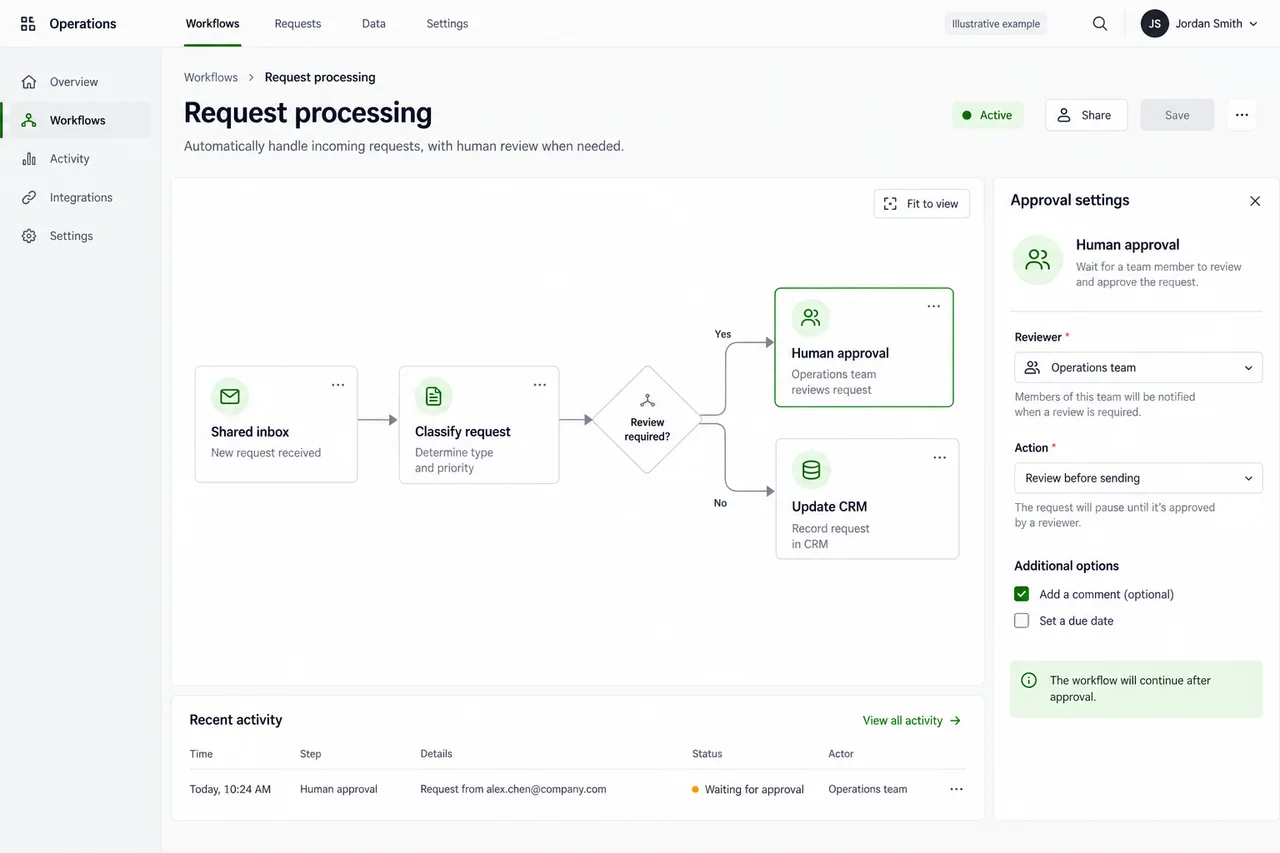
Example workflow editor connecting an inbox, request classification, human approval and a CRM update.
Illustrative application concept

Rules that travel

Schools and universities in many countries work from similar guidance. UNESCO's 2023 guidance on generative AI notes that institutions are largely unprepared to validate AI tools, and asks for data privacy protection and a human-centred, age-appropriate approach to validating tools. The AI Literacy Framework from the European Commission and the OECD, published in June 2026, gives schools a common reference for teaching about AI. The EU AI Act treats AI that admits students, grades their work (including to steer their learning) or monitors them during tests as high-risk from 2 December 2027 (as amended in July 2026). Our work is for staff only. Your own education authority's rules always come first.

Which rules apply to you is your compliance or legal team's call. We map our evidence to them; we don't certify against them.

The problem

In Australia, full-time classroom teachers spent 6–9 hours a week on administrative tasks in 2023. Finding the current procedure means old handbooks, shared drives or emailing someone.

Staff ask in Teams or on a web page and get the answer with its section and version, or "not in our documents".

AITSL, National Trends: Teacher Workforce (June 2025), as at

How the work flows

Answer policy questions

Switch on what you own

  • Admin Hours Audit + Switch-On

    ⑤ AI Switch-On

    Independent schools; no school kit, so your AI policy applies.

Choose a new AI tool

Test the AI you've deployed

Staff policy assistant

Question
Who approves an overnight excursion?
Answer
The principal, once the risk assessment is signed.
Cited
Staff Handbook, section 7.3, version 4
  • ok: Current version cited
  • review: Two handbook versions found
  • blocked: Restricted HR procedure hidden

Sources

  1. Staff Handbook (fictional) Section 7.3, version 4
Illustrative interface, fictional data

What we build for education

  • Policy & Procedure Assistant

    ② Knowledge Assistant

    One policy and procedure library for one staff group, delivered inside Microsoft 365 (Copilot, SharePoint or Teams) where you license it, otherwise on the web. Answers cite the policy, section and version, and say "not in our documents" when the library is silent.

  • Admin Hours Audit + Switch-On

    ⑤ AI Switch-On

    The Admin Hours Audit takes 1 week and maps where staff hours go. Switch-On takes 2–3 weeks: it configures features you already own; for firms in Australia, it applies the relevant Safe-Use Kit as published, where one has been published; and it trains staff and measures the hours saved at day 30.

Use your platform's AI first

If staff have Microsoft Copilot licences, SharePoint's built-in AI already answers from your policy libraries within existing permissions. Gemini for Education comes with every Google Workspace for Education edition. If either is good enough, we'll say so.

What we don't do

  • We don't build student-facing tutors or chat tools.
  • We don't build anything that admits, grades or monitors students.
  • We don't compete with the AI chat tools education systems provide, such as NSWEduChat, SA's EdChat and cechat in Australia.
  • We don't write AI policies or privacy-policy wording.

Illustrative scenario: not a client engagement

A staff policy library that answers, or says it can't.

  1. Problem

    A fictional two-campus independent school keeps about 180 staff policies in SharePoint, some in several versions, and staff email the same questions every week.

  2. Approach

    Eight staff write 40 questions with known answers and agree the threshold. The assistant reads one collection, with SharePoint permissions, and cites section and version.

  3. How we'd measure

    • False answers and false refusals, counted separately
    • Citations to the current version
    • Restricted documents hidden from test accounts
  4. What ships first

    After the go/no-go, the assistant in Teams for one staff group, with its acceptance-test report.

Policy questions, answered or refused Illustrative trace
  1. 08:40:00 testset.load Staff-written questions loaded 40 questions
  2. 08:41:10 answer.cite Excursion question answered, section and version shown
  3. 08:41:30 answer.refuse Uncovered question: "not in our documents"
  4. 08:45:00 report False answers and false refusals counted separately

A first engagement in education

What we need from you

  • A policy owner for about 2 hours a week
  • 5–10 staff to write 30–50 questions with known answers
  • Read-only access to one policy collection

What you get

  • An error rate, with false answers and false refusals shown separately
  • The gaps: unanswered questions and conflicting versions
  • A data note and a go/no-go decision point

The exit ramp

At the go/no-go, you decide whether to continue. If the error rate misses your threshold, or Copilot or Gemini already does the job, you can stop there and keep the questions and results.

Australia: our detailed map

Australia is our home market and the one we know best.

Designed around

Works alongside

  • SharePoint and OneDrive Read-only access
  • Google Drive Read-only access
  • Microsoft Copilot interaction history Read-only access
  • ServiceNow knowledge base Read-only access

Regulatory map

Regulatory map
ObligationWhat it means for an AI systemHow we design for itEvidence you getSource
Australian Framework for Generative AI in Schools, 5.2 Reliability and 5.3 MonitoringThe Framework (national guidance, not law) expects tools to be tested before use and to work as intended, and their impact on school communities to be monitored so emerging risks are managed.An acceptance test on 50–100 questions your staff write, re-run when the AI model changes.A test report listing every failure, false answers and false refusals counted separatelySource, as at 17 June 2025
Australian Framework for Generative AI in Schools, 6.1 Privacy and 6.2 Privacy disclosureThe Framework (guidance, not law) expects generative AI to be used in ways that comply with Australian law, avoid unnecessary collection, limit retention and prohibit the sale of student data, with communities told what is collected and shared and consent sought where needed.The assistant reads staff policies only, never student records, and log retention is agreed with you in writing.A one-page data note: what is read and logged, for how long, and where it's processedSource, as at 17 June 2025
HESF 2021 Standard 6.2.1(e), kept in force by s 7(2): material risks managed and mitigated (becomes 6.2.1(f) from 1 Jan 2027 for Table A Australian Universities, 1 Jul 2027 for other providers)A registered provider must be able to show, and its governing body assure itself, that material risks to its operations are managed and mitigated. The standard doesn't name AI; a deployed AI tool's material risks fall under it.We test the tool you deployed on your questions and rate findings against your risk matrix. We never independently evaluate a tool we built, configured or advised on for you.An Independent Evaluation Report with rated failures, and a replay script your team can re-runSource, as at 14 July 2026
Privacy Act Sch 1, APP 6 and APP 10, as applied in OAIC guidance on AI productsFor private schools, private higher-education providers and ANU, APP 6 limits the purposes for which personal information may go into an AI tool, APP 10 requires reasonable steps to keep AI output about people accurate, and the OAIC expects regular reviews.We state where inference runs and the provider's retention and human-review settings, and measure accuracy on your questions.A data note on inference location and provider settings, plus the measured error rateSource, as at 17 January 2025

Last reviewed

General information, not legal advice.

Questions

Will your evaluation report satisfy TEQSA?
No one can promise that. The report gives your governing body findings rated to your risk matrix, the method and a replay script: findings, not an assurance opinion.

Related insights

Questions

Have you done this for a school or university before?
No. Techsider has no clients yet, in education or anywhere else. So the first engagement is a two-week trial on your staff's questions, with every failure shown.
We already have Copilot or Gemini. Why would we need this?
You may not. If SharePoint's built-in AI or Gemini for Education answers well enough, we'll tell you. We add a test on your own questions that counts false answers and false refusals.
Will student information go into the assistant?
No. It reads staff policies and procedures only; student records and wellbeing notes are out of scope. The data note lists what it reads and logs, and for how long.
Can you evaluate the Copilot set-up you configured for us?
No. We never independently evaluate a system we built, configured or advised on for the same institution. We can give another evaluator our results, labelled as not independent.

Let’s discuss your workflow.

Talk to us about AI for education