industry

Know what your AI scribe leaves out.

Evaluate AI tools before relying on their outputs.

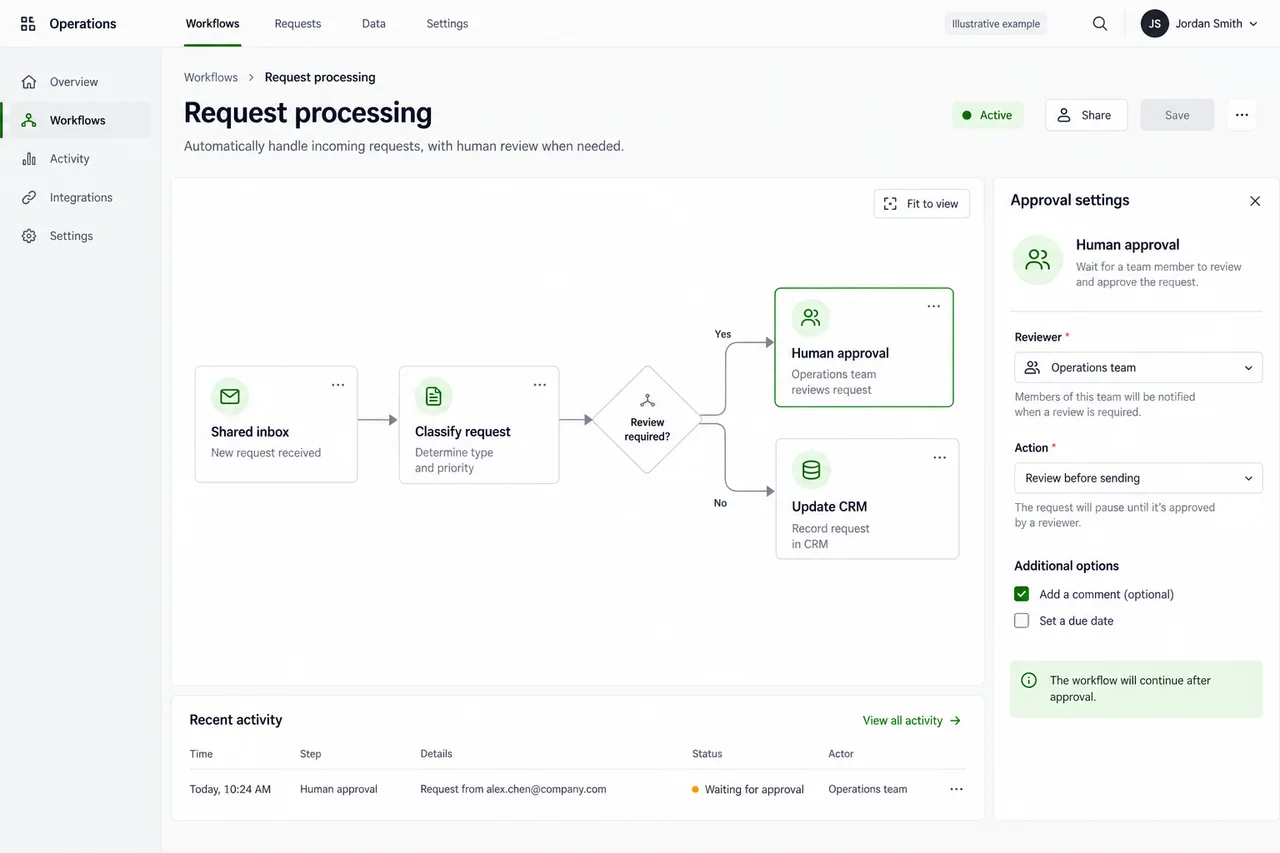
Example workflow editor connecting an inbox, request classification, human approval and a CRM update.
Illustrative application concept

Rules that travel

Health systems differ, but the questions about AI documentation tools are converging. The World Health Organization's 2024 guidance on large multi-modal models warns of automation bias in health professionals and patients. The good machine learning practice principles, first published by national regulators, ask for testing in clinically relevant conditions, attention to how clinician and AI perform together, and monitoring once a model is deployed. In the EU, AI that is a medical device, or a safety component of one, is high-risk from 2 August 2028 (as amended in July 2026) where the device needs third-party conformity assessment. Each country's regulator decides when an AI scribe becomes a medical device. We don't make that call; we measure what the scribe gets wrong, and your regulatory team decides.

Which rules apply to you is your compliance or legal team's call. We map our evidence to them; we don't certify against them.

The problem

In Australia, a scribe arrives through a vendor demo or a software update, and what it leaves out of notes in your specialties hasn't been measured.

Each AI tool is tested on your own scripted consultations before rollout and after each update, with omissions and additions counted.

ACSQHC, AI Safety Scenario: Ambient scribe (v1.0), as at

How the work flows

Select

Validate

Re-test

Administration

Scope test: scripted knee review

Specialty
Orthopaedics
Version tested
Fictional Scribe 4.2
  • ok: Medication and dose match the reference note
  • review: Omission: follow-up interval missing
  • blocked: Addition: imaging the clinician never said

Sources

  1. Reference note Plan, line 3
Illustrative interface, fictional data

What we build for healthcare

  • Scribe & Clinical AI Evaluation

    ④ AI Evaluation

    The health form of the Independent Evaluation Report: selection against the regulator and safety guidance that applies to you (in Australia: TGA, Ahpra and ACSQHC), local validation on your own specialties, omission audits and a monitoring plan for after go-live. We evaluate these products; we never build them.

  • Policy & Procedure Assistant

    ② Knowledge Assistant

    One policy and procedure library for one staff group, delivered inside Microsoft 365 (Copilot, SharePoint or Teams) where you license it, otherwise on the web. Answers cite the policy, section and version, and say "not in our documents" when the library is silent.

  • Credentialing & Referral Intake Registers

    ① Document RegistersOn request

    Reads credentialing documents from outside the national practitioner register (Ahpra in Australia), such as college fellowships and scope-of-practice letters, or referrals that arrive as PDFs or faxes, into a register a person checks. Administrative only: a person makes every credentialing or referral decision.

Use your platform's AI first

If your staff have Microsoft Copilot licences, SharePoint's built-in AI can already answer from a policy library within each user's permissions. Try it first; we'll say whether it's good enough.

What we don't do

  • Build scribes, or anything that interprets clinical conversations.
  • Build clinical coding or imaging AI. We evaluate those products instead.
  • Give clinical advice. The Policy & Procedure Assistant answers from non-clinical policies only.
  • Take on work that needs a US HIPAA business associate agreement.

Illustrative scenario: not a client engagement

A scribe pilot that went beyond general practice.

  1. Problem

    A fictional day-surgery group licensed a scribe after a GP-based demo. Its specialists say details go missing, and an update added next steps nobody asked for.

  2. Approach

    Clinicians role-play scripted consultations and write reference notes. Two clinicians label what the scribe leaves out or adds, and a scope test checks for any diagnosis, test or treatment never said.

  3. How we'd measure

    • Omissions per note, by specialty
    • Scope-line breaches before and after the update
    • Agreement between the two raters
  4. What ships first

    The week-0 threshold sheet and the scripted consultation set.

Scope test on one scripted consultation Illustrative trace
  1. 09:00:00 scribe.replay Scripted knee review run through the scribe
  2. 09:00:06 note.compare Output lined up against the reference note
  3. 09:00:09 scope.flag Imaging suggestion flagged: never said

A first engagement in healthcare

What we need from you

  • A clinical lead who owns the thresholds.
  • Clinicians from each specialty to script, role-play and label consultations.
  • A test account in the scribe you already license.

What you get

  • An evaluation report with omissions and additions counted separately, and every failure listed.
  • The scope-test log for the version tested.
  • The test set and replay script, to re-run after each update.

The exit ramp

Once the scripted consultations and thresholds are agreed in week 0, and before testing starts, you decide whether to continue. If you stop, you keep the test design.

Australia: our detailed map

Australia is our home market and the one we know best.

Designed around

Works alongside

  • Microsoft SharePoint Read-only access
  • Halaxy (with the API add-on) Read-only access
  • Cliniko Read-only access

Regulatory map

Regulatory map
ObligationWhat it means for an AI systemHow we design for itEvidence you getSource
TGA Digital scribes guidance: a scribe that analyses or interprets is a medical deviceA scribe intended only to transcribe or translate a consultation into a written record, without analysis or interpretation, is not a medical device. One that analyses or interprets, for example by generating a diagnosis, differential diagnosis or treatment recommendation the clinician didn't state, is a medical device and must be in the ARTG before supply. A software update can move a product across that line.The scribe evaluation includes a scope test for any diagnosis, test or treatment the clinician never said, re-run on each vendor update.A scope-test log with the product version testedSource, as at 30 January 2026
ACSQHC AI Clinical Use Guide v1.0 and Ambient scribe scenario: 'while you use' and 'after you use' stepsThe guide and scenario ask clinicians to review scribe summaries for hallucinations, over-summarisation and missing information, label records AI helped create, and take part in regular reviews of how the scribe performs.We count omissions, additions and errors separately, and hand over the test set so your clinicians can re-run it.An evaluation report and the re-runnable test setSource, as at 1 August 2025
Ahpra and National Boards AI guidance: Accountability and Informed consent principlesThe practitioner must apply human judgement to any AI output and check the accuracy of records a scribe creates, and generally needs the patient's informed consent before a scribe records. Ahpra says tools should be tested by the user or organisation for fitness for purpose before clinical use.Testing happens before clinical use, against thresholds your clinicians agree in week 0. It never replaces a clinician's review of each note.A pre-use test report with the agreed thresholds and every failureSource, as at 22 August 2024
Privacy Act s 6D(4)(b) and OAIC guidance on commercially available AI productsPrivate health service providers that hold health information are covered by the Privacy Act at any turnover, so AI that handles health information is subject to the APPs. The OAIC expects due diligence on whether a product was tested for your use, and regular performance reviews rather than 'set and forget'.Evaluations run on scripted or consented material inside your environment, and we record where each processing step runs.A one-page data note naming where each step runsSource, as at 17 January 2025

Last reviewed

General information, not legal advice.

Related insights

Questions

Have you evaluated a scribe before?
No. We have no clients yet, in health or anywhere else. Judge the method in our scope instead: sample size, reference notes, rater agreement and how omissions are counted.
Does patient data have to leave our environment?
No. The test uses scripted consultations, not patient records, and the replay script runs in your own Microsoft or AWS account.
Will your report sign off the scribe?
No. You get findings rated to your risk matrix and every failure listed. Whether a product is a medical device is your regulator's call (the TGA in Australia), not ours.
Do you take commissions from scribe vendors?
No. We take no resale margin or referral fees from vendors we evaluate, and disclose any vendor relationship. We never issue an independent evaluation of a system we built, configured or advised on for you.
We're a public health service. How do we engage you?
Directly, or through the Evaluation Partner route: we run the evaluation as a workstream under your existing prime, internal-audit co-source firm or law firm. Findings map to the AI policy your health system applies.
Do you cover life sciences?
One package, on request: the Compliance Dossier Builder turns the documents an audit or inspection asks for into a register linked to source pages.

Let’s discuss your workflow.

Talk to us about AI for healthcare